


The Waldorf approach to science
“You will injure the child if you introduce abstract ideas too early. First, let them experience and observe; then, they will come to understand.” – Rudolf Steiner
As Steiner suggested in the quote, science must not be taught through formulas, definitions, and problem-solving exercises, but by a more natural and holistic approach. The Waldorf approach takes a fundamentally different route. Instead of introducing abstract concepts first, it begins with real-world experiences, observation, and experimentation. This method encourages students to develop a deep, intuitive understanding of physical laws before moving to theoretical explanations. Tridha, a Waldorf-inspired school in India, embraces this methodology, ensuring that students develop not only scientific knowledge but also a sense of wonder and curiosity about the world.
The Waldorf Approach to Science:
Waldorf education introduces scientific concepts progressively, aligning them with the developmental stages of children. In the early years, young learners engage with nature through storytelling, exploration, and hands-on experiences rather than abstract theories. As they grow older, their learning shifts from experience-based observation to guided inquiry and experimentation.
“The first thing to be done is to educate the eye to accurate observation, the hand to deft action, and the mind to clear perception of the external world.” – Rudolf Steiner
A key principle of Waldorf science education is phenomenology, where students first observe natural phenomena without immediate explanation. This allows them to form their own questions and insights before being introduced to scientific theories. For instance, a physics lesson might begin with students witnessing two forks hanging on a thin toothpick on the edge of a glass rather than immediately studying the center of gravity. This approach nurtures curiosity, critical thinking, and a deeper connection to the subject.
Another defining feature of Waldorf science teaching is its interdisciplinary nature. Science is not taught in isolation but integrated with art, history, and philosophy. This holistic approach helps students see the interconnectedness of knowledge rather than compartmentalizing subjects.
How Tridha Incorporates the Waldorf Science Approach
Tridha follows this unique methodology to make science both experiential and meaningful for students.
“Before explaining the laws of nature, bring the child into living contact with them, so that they feel science as a human experience, not as a mere subject.” – Rudolf Steiner
1. Learning Through Observation and Experimentation
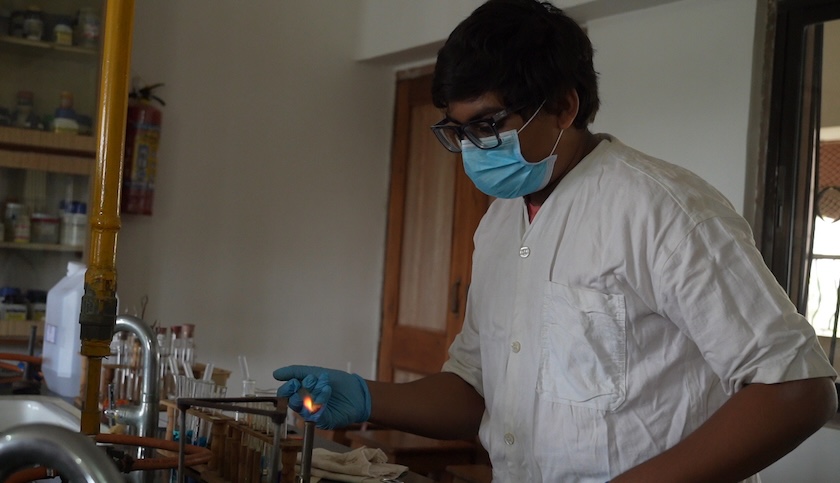
Science at Tridha begins with direct experiences. For example, rather than starting with Newton’s laws, students observe real-world motion—watching a ball roll down an inclined plane or feeling the force required to push a heavy object. Similarly, the principles of optics are introduced by observing light passing through a prism before discussing refraction and dispersion.
Electricity lessons begin with simple experiments like rubbing a balloon on hair to observe static electricity before introducing concepts like charge and electric fields. Instead of memorizing formulas, students explore these ideas through guided experiments, fostering curiosity and deep understanding.
2. Phenomenology in Science
Tridha applies the phenomenological approach by allowing students to experience physical phenomena before explaining the laws behind them. For instance, heat expansion is demonstrated by heating a metal ring and observing how it no longer fits over a metal ball, leading to discussions on thermal expansion. Similarly, sound waves are explored by feeling vibrations from a tuning fork before discussing frequency and amplitude.
3. Artistic Integration and Physics Journals
A unique aspect of Waldorf education is the integration of art into science learning. At Tridha, students create detailed sketches of experiments, such as the path of projectiles or the structure of circuits. Instead of standard textbooks, they maintain main lesson books, where they illustrate concepts, write reflections, and describe experiments in their own words. This approach helps them internalize concepts in a creative and meaningful way.
4. Storytelling and Historical Context
Physics is not presented as a set of dry principles but as an evolving story of human discovery. Students learn about Archimedes’ principle through the legend of the overflowing bathtub and Galileo’s experiments by reenacting them. The life stories of Newton, Ohm and Curie are woven into lessons, inspiring students to see science as a continuous journey of exploration.
5. Connecting Science to Everyday Life
At Tridha, science is not confined to the classroom. Concepts are linked to real-world experiences—understanding forces by analyzing the mechanics of a bicycle, exploring aerodynamics by making paper airplanes, and experimenting with water pressure using simple home-based setups. This ensures that physics feels relevant and applicable.
6. Science into action
Beyond observation and experimentation, Tridha emphasizes applying scientific knowledge through hands-on projects. At the end of each block, students transform their learnings into fully functional models, allowing them to demonstrate their understanding in practical, creative ways. This process not only deepens comprehension but also instills problem-solving and innovation skills.
“Science should be taught artistically so that its principles emerge from the beauty and wonder of nature.” – Rudolf Steiner
By following the Waldorf approach, Tridha makes science an adventure of discovery rather than a subject of rote learning. Through observation, experimentation, storytelling, and artistic integration, students develop not just knowledge but a deep appreciation for the fundamental forces that shape our world. This holistic approach ensures that science is not just learned—it is experienced.
This post has been authored by Akash Jaiswal, physics Teacher at Tridha