


Hurried childhood
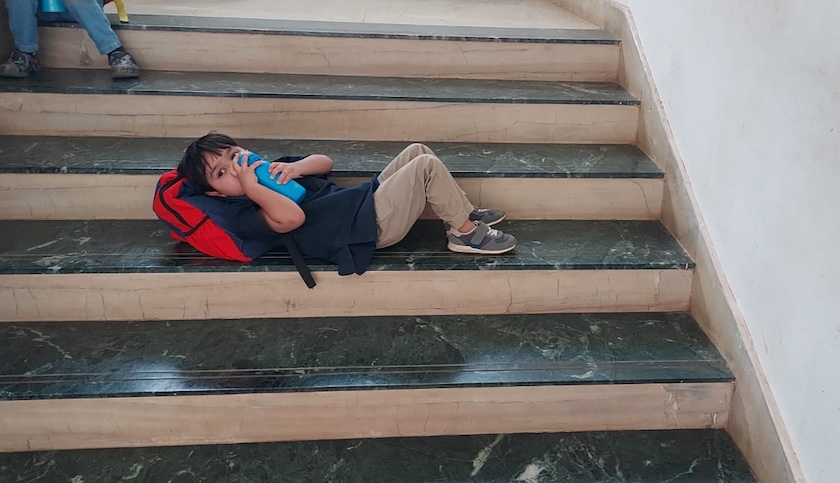
Not long ago, a New York Times article highlighted the importance of giving children an unhurried childhood, without an overpacked schedule of extracurricular activities and excessive homework. The pressure to excel at a young age has led to increasing mental health issues among children. School is not a safe haven, but a time machine that takes children to destinations far before they are meant to reach them.In olden times, there was a phrase in relation to precocious children – ‘early ripe, early rot’. Here is an internet page excerpt about using black and white cards to boost learning in 2-month-old babies.
‘Show your baby a complex black & white card a few times in a row. Wait until they look away before you put the card down; when they look back, hold it up again. After a few repetitions, show them a different card or the same one rotated in a different direction. When they remain focused on an image or see it a few times, their brain is working to notice what’s different. In addition, provide visual stimulation during diaper changes and keep talking about what they see.’
Today’s pressures on children to grow up fast begin in early childhood. Chief among them is the pressure for early intellectual attainment. Parents are told that if they do not start teaching children when they are young, a golden opportunity for brain enrichment would be lost. Children are learning to read, write and count at an increasingly earlier age. The emphasis on early intervention and early intellectual stimulation in children has made the idea of readiness, which was once an honoured educational concept, now almost obsolete.
Not too long ago, summer camps and activity centers were few, and limited to offering extracurricular activities. Today, as soon as children are in kindergarten, parents are confronted with countless options for ‘brain boosting’ workshops and online programs, programs to raise emotional quotient, to have increased control over emotions, to socialise better, improve memory power, improve academic performance, to have better focus and confidence, and to learn to believe in themselves. There are after-school classes on Vedic Math, abacus, phonics, creative writing, coding, robotics, and what not.
Dr David Elkind, a child psychologist, coined the term ‘hurried child syndrome’. He describes it as “a set of stress-linked behaviours, which result when a child is expected by his (her) parents to perform well beyond his or her level of mental, social or emotional capabilities. Basically, parents overschedule their children’s lives, push them hard for academic success, and expect them to behave and react as miniature adults.”
Children are taken to tutors to get a head start on reading before starting school. They are exposed to unchecked content on the internet and on television. There is hardly any information in the modern world that is limited to the adult world today. Children have quick and easy access to anything they want, online. They are asked to be disciplined, organised, and socially aware, where success is all-important and grades are everything. Interestingly, parents are also increasingly discussing marital and financial problems with their children. Sometimes our tendency to think of children as not sharing our feelings leads us to compound the stress of hurrying in a different way. When we are in a hurry, we are thoughtless towards their needs.
All these issues lead to chronic stress. The child feels restless, irritable, unable to concentrate, and confused. It has led to modern day problems like school burnout, a plethora of academic difficulties, and learned helplessness. Many children acquire learned helplessness at school when they are confronted with learning tasks that are too difficult for their level of ability. Some children fail to learn to read because the way in which it is taught confronts them with a task they cannot comprehend or control.
It isn’t then surprising, that cyber-bullying, watching pornography, violence, usage of cigarettes, alcohol and drugs, theft and vandalism have become increasingly rampant among minors.
Kirti (name changed) completed his schooling at the age of 9. At the age of 11, he scripted history by securing a BSc, and an MSc by age 12. Thereafter, Kirti went on to pursue his PhD. At the age of 22, Kirti was offered a position as an Assistant Professor at the IIT-Mumbai campus. However, the employment came to a termination in a few years after he reportedly took an extended sick leave from the institute. Kirti has been unemployed since then. Even a so-called child-prodigy should by no means precede academic milestones before they come of age. There is a time, and purpose for everything.
Our education system has been deeply influenced by the “need for speed”, or what sociologist George Ritzer has termed “McDonaldization” – that is, “the process by which the principles of the fast-food industry are coming to dominate more and more sectors of the world.” Author Shelley Wright states, ‘if a student is not quite ready to read when reading is “introduced,” then they often pay the price for being “too slow”. Kids are labelled as being not “academic,” as if being academic is the most important quality a child can possess. Creativity is quashed. Curiosity is quelled. Disengagement is rampant.’
As Honoré states, “We are doing a great disservice to our children by pushing them so hard to learn things earlier and earlier and by keeping them so busy. They need time and space to slow down, to play, to be children. Across the world, parents, politicians, adults in general are so anxious about children nowadays that we have become too interventionist and too impatient; we don’t allow them enough freedom.”
At Tridha, we follow a "slow-paced" learning approach, prioritizing a child's natural developmental stages and allowing time for deep exploration and engagement with concepts through play-based activities, rather than rushing through academic material quickly; this means delaying the introduction of formal reading and writing until children are developmentally ready. These guidelines help children remain children, and discourage the fast forwarding of childhood.
The conception of "slow learning" means encouraging children to stay young as long as possible; the children aren't really asked to learn very much, they are encouraged to play and fantasise instead. At Tridha, therefore, one of the main tasks of the teachers is to protect childhood.
We work with curriculum that has greater depth than breadth. Up to Senior kindergarten, there is absolutely no academic work. Students play outdoors, sing, listen to stories, cook, clean, and engage in imaginative play. Up to age 12, we do not use textbooks and steer clear of marks and grading, and the use of the “birth year” is our primary criterion for introducing content and skills. Thus, we have the possibility of educating children in a way that helps them to develop into people who are happy, healthy and humane.
This post has been authored by Navjyoti Brillant, our Head of Primary, & Trustee of Tridha