

Cradle of the Early years – Part 3
A little Peep in their world.
When you enter the realm of the Garden at Tridha, do it very gently. There is music in every care. Each age group strikes the notes differently. The way they play is well ordered and as per their development. There is an archetype behind the way they play. The colours in the care have an ethereal effect. Life is different. Movement is gentle and it’s through movement they feel themselves and participate in life activities. All the play materials/ toys are like artefacts in the care. It’s up to the discretion of the caregiver how she would like to introduce the play materials in her kindergarten.
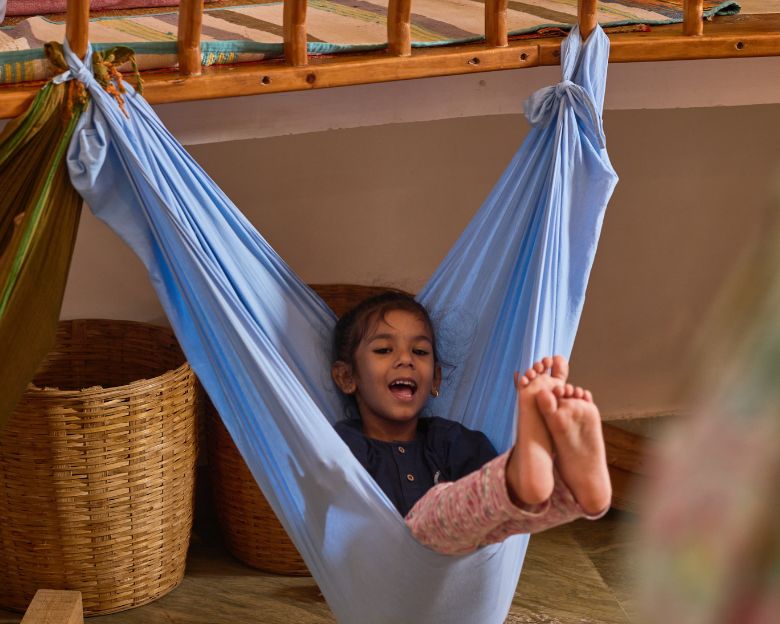
Let us look at the kind of play that occurs from the youngest child from birth until the change of teeth. Imagine it like a story. If only we had very little newborn ones - they would be playing with their hands or little rattles. Little ones actually play with their own movements. Then you look at the slightly older ones and around 2 years they usually like stacking cups. They are often seen with buckets filling and emptying things. You will see they are most of the time with the caregiver. Walking besides them. Toddlers enjoy pretend play- doing their daily routine Some like to have soft animals. Here it’s the caregiver who decides what the children need in her care. The 2- to 3-year-olds are often seen carrying dolls or an animal carefully handmade by the teacher, which they can cuddle. You may see them putting them to sleep or feeding them imitating their parents.
Before 3 years of age, play often takes place in open spaces/ large spaces with toys scattered. 3-year-olds are developing their fine and gross motor skills. They are often turning things into a story. They look for closed spaces- under tables and behind curtains. There are innumerable variations of cubby house building inside and outside, peeping through.
The 4-year-olds’ playing skills are developing and they gather a lot of materials to play with. At this age, inclusion is a very important theme. There is room for everyone. “Let’s make our house bigger”. At times you may see them with strings. And there it goes they are stringing the whole kindergarten room. So well they “Weave the world”.
5-year-olds are often seen building blocks, playing hula hoops (outdoor), busy with crafts like stringing beads. They gather plenty of materials and build elaborate play scenarios. This is the Golden age and it’s a wonder to watch them play.
6-year-olds are the workers in the care. They participate in all the chores. They are given responsibility which they joyfully do. In fact, they look forward to helping their teachers. They may spend the entire time planning or creating a city, but never really playing it. They are now getting ready to move on from the Cradle of the kindergarten to Consciousness of Grade School.
Many sawed up branches made into blocks, pieces of tree bark, roots are kept in the care as the cleverest thing can be made out of these. They can be used in puppet shows. Sand play is offered outdoors for various sensory experiences. Play from “inside out” more than any other kind of play needs time, a quiet space and adults who listen, accept and support whatever the child plays out from within. Free play is actually when the child chooses their own toy to play with and the play is also self-initiated.
A beautiful example in an outdoor play where a lot is happening, and materials bring some cooperation. A boy finds some tree branches. He takes them to the centre of the garden. He puts the largest one where he finds the soft mud. He puts it upright and with all his strength it goes firmly in the mud. Two more 6-year-olds join him. They get some more logs and hammer them in the same way. The boy lines many in a row. They find some broad wooden pieces of wood and lay them across the logs. They are trying to make a bridge with lots of sticks. They are at the same time protecting it, so it doesn’t fall. Many times, it’s nice to “See while looking” when we see children at play on the street side. While this play is important for the development of thinking, of making sense of the world. It’s also non-intellectual. The exploratory activity of the child itself, not any explanation given by an adult is regarded by Steiner as beneficial for the development of thinking.
What about closed ended toys? They too have a purpose. There is a correct way to use them. These could be ideal for an older kindergartener who will slowly move from the “Cradle of the kindergarten” to School. They often have specific goals like puzzles. Shapes, sorters with the wooden blocks. These toys help develop focus; practice following instructions and build confidence as they achieve the intended result. Other closed ended materials are pentatonic musical instruments, pop up picture books made by the caregiver etc. by offering a balance of both, we can support a child’s creativity and cognitive development.
Everything has its place. A variety of open ended and closed ended materials encourage independent and self-directed play. A toy shelf can have a set of building blocks, many play materials of different sizes and colours, wooden animals and people, a small wooden train, wooden house. On play materials, Steiner believed that in the first few years the child is most sensitive and is unable to filter out information. He said we need to nourish their sense organs. For this reason, toys and resources are made out of natural materials such as wood, cotton. Wooden material/toys have a sense of life in them. They give the child a realistic sense of weight when lifted. With the natural materials what we have observed is that children respond on an emotional level.
Certainly, the best toy in the care is the one made by the adult/ mother/caregiver. What about the Doll? He said it needs to be so simple that it can be made by tying knots in a handkerchief. In the earlier times many children used to play with their mother’s and father’s handkerchiefs and a story would be narrated. It was just so simple. Fewer toys readily available assists the child to engage in deep, self-directed play. Children benefit from having a simpler environment with fewer choices and towards the end of the day, all play materials are put back at the same space. It’s the responsibility of the Adult to put them away.
Steiner spoke about “well guided play” not in the sense of directing, redirecting, but as involvement of the adult in her own work, alongside playing children, leaving the children free to follow their own inclination in play.
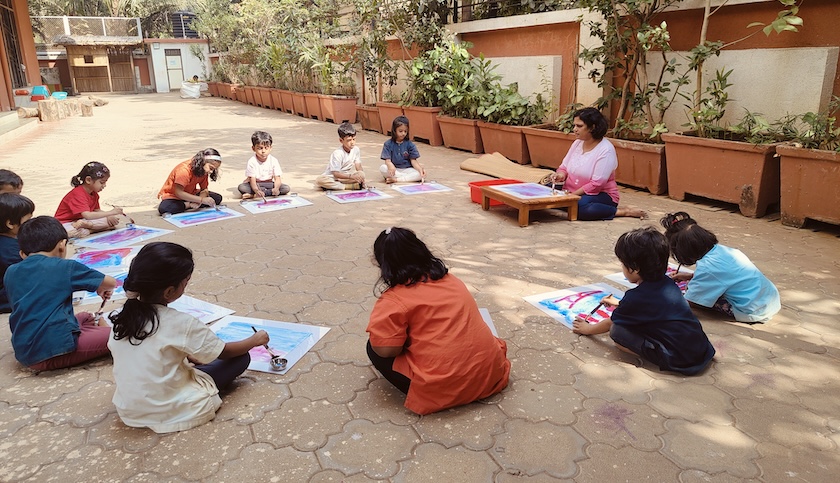
Life is the curriculum. In the early years the task of the caregiver is to adapt to practical activities of daily life so that they are suitable for the child’s imitation through play. The work and play in the kindergarten must be derived directly from life itself rather than being “thought out” by the intellectualised culture of adults. In the kindergarten, the most important thing is to give the children the opportunity to directly imitate life itself.
Bridge between the two worlds
Knowing that we are in different times. The Digital times! but let’s together look where our children are. What do they want from us? They are still coming into their bodies. Are we walking with them? Are we listening to them? Do we know where they belong? Life forces - what about them? There are processes of forming, shaping and growing occurring between birth and the 7th year. Inner organs are still taking shape. The “gates of this special garden” need to open at the right time. Let’s protect this little world inside.
Protection for the forces of Childhood
Although it is highly necessary that each person should be fully awake in later life, the child must be allowed to remain as long as possible in the peaceful dreamlike condition of pictorial imagination in which his early years of life are passed. For if we allow his organism in a non-intellectual way, he will rightly develop in later life the intellectuality needed in the world today. (Rudolf Steiner, A modern art of education).
This post has been authored by Vidya Iyer, former Kindergarten Teacher and Coordinator