


A gentle education: Learning at the pace of childhood
Rudolf Steiner said, “We will get far enough in the first grade so that the children will be able to write simple things that we say to them or that they compose themselves. If we stick to simple things, the children will also be able to read them.”
I am more than happy to be a drop in the ocean of this man’s vision, who initiated Aaldorf a hundred years ago and I firmly believe that the Waldorf way of learning is so much more significant today just as it was a hundred years ago.
In my imagination ‘Waldorf’ is synonymous with living inside the pages of a fairy tale! The world, its pressures, the spirit of competitiveness and the pressure to prove oneself at a tender age is like the thief stealing away innocence from little ones and ‘Waldorf’ appears like an oasis for the dignity for children and a custodian of innocence, keeping the soul of the child hidden and protected from the pressures of modern education.
Modern lifestyle and structured routines have robbed children of their precious playtime and as I write, I reminisce about the poem, ‘Leisure’ by WH Davies. “What is this life, if full of care, we have no time to stand and stare”
These words remind us about simplicity and a life which ought to be lived in accordance with nature, appreciating the beauty of nature and with a ‘lust for life’. ‘Steiner’s Waldorf’ does just this for the soul of the child. The child learns and grows wholly yet slowly in a leisurely manner in the process of loving the beauty of learning.
The Waldorf cuisine has some very important ingredients which we celebrate as the feast of childhood. ‘The Three Day Rhythm’ starts with a strong emphasis on the early years when children learn through the senses and imitation. Where a concept is introduced on the first day. Better absorbed on the second day and understood and familiar on the third day. This rhythm is applied to stories, songs, concepts and activities as a daily routine.
The ‘Main Lesson’ which is an incredible start to an extravagant journey which the child begins at age seven. And on this journey of learning, the child begins to take tiny steps on the path of dreaming and imagination thereby recording the learning of stories, songs and concepts through ‘drawing’. Steiner’s Waldorf provides this magical sense of ease and leisure as the child learns to process letters and stories and verses and songs in the soul first.
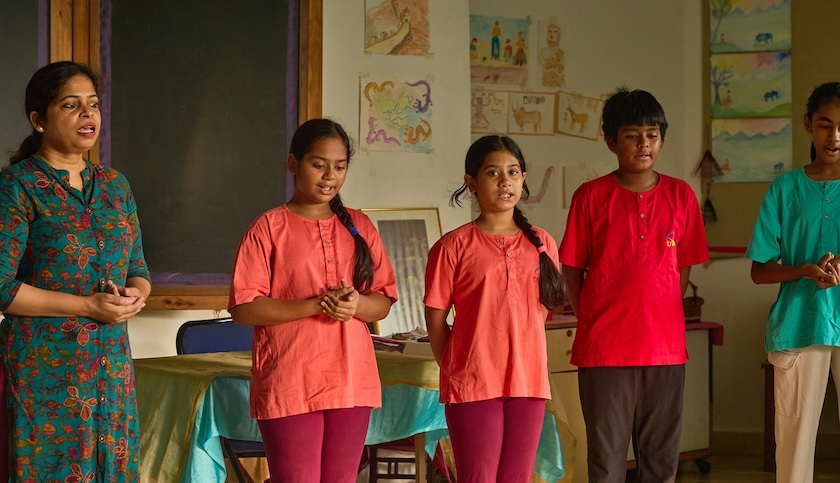
Yet another especially cherished traditional ingredient is the ‘Circle Time’. Emerging gradually from the dreamy world of early childhood and stepping into the pages of a fairy tale in grade one, the story is told and retold by the teacher until it is absorbed into the soul of the child, creating the foundation for reading, developing language skills through poetry and verse. In the first lesson they learn to draw a picture and find the letter related to the story in it.
All these ingredients put together help children begin their reading appetite at their own pace and time.
In this time and age when the world is thoroughly consumed with strife, consumerism and spiritual degradation fueled with learning systems which desperately want to turn every child into a ‘prodigy’ . When the true essence of learning is compromised with unrealistic competition and unnecessary ambition in the early years resulting in children growing up to be exhausted and disillusioned by the pressures of academic expectations placed upon them.They despair for a sound sustenance of wisdom and peace, which only a sound education can provide. Not the education which intends to prove the child’s abilities at age seven rather a spiritual learning process which sustains the soul of the child from (0 to 7) (7 to 14) & (14 to 21)
If all the children everywhere in the world learnt like they do in the Waldorf method, we would truly be able to say, “This is the life filled with gentleness and care, we have all the time to stand and stare!
This post has been authored by Mallika George, Tridha Librarian